When Do 10-K Filings Come Out? A 2021–2025 EDGAR Acceptance-Time Study
We studied 34,651 Form 10-K filings from 2021–2025: 74.69% were accepted in February or March, and 63.03% at or after 4 p.m. ET.
Quick answer: Exact Form 10-K acceptances clustered in February and March. They also skewed late in the day. We analyzed 34,651 unique EDGAR accessions whose quarterly-index form type was exactly 10-K and whose official filing date was from January 1, 2021, through December 31, 2025. We counted each accession once.
EDGAR accepted 74.69% of these accessions in February or March and 63.03% at or after 4:00 p.m. Eastern Time. These percentages describe separate dimensions. The joint result is 38.33% for the narrower combination of February or March and 4:00 through 5:29 p.m. ET.
The median acceptance time was about 4:15 p.m. ET. The busiest date in the study was March 31, 2022, when EDGAR accepted 652 Form 10-K filings.
Here, “hit EDGAR” means accepted by EDGAR. It does not mean the first moment when a filing became visible on sec.gov. That distinction matters.
Data snapshot collected and checked on August 12, 2026.
| Related concept | What it means | Answer |
|---|---|---|
| 10-K deadline | Due date after fiscal year-end | Generally 60, 75, or 90 days, based on filer status |
| EDGAR operating hours | When EDGAR accepts transmissions | 6:00 a.m. to 10:00 p.m. ET on operating weekdays |
| EDGAR acceptance time | The timestamp measured by this study | Median about 4:15 p.m. ET; 63.03% at or after 4:00 p.m. ET |
| First public availability | When an investor could first load the filing | Not exactly measured by the SEC acceptance timestamp |
The Main Results
All counts below are accession-level. Unless a table says otherwise, percentages use 34,651 unique accessions as the denominator and are rounded to two decimals. As a result, displayed percentage columns can total 99.99% or 100.01%.
The strongest results are:
- 25,880 filings, or 74.69%, were accepted in February or March.
- March accounted for 16,379 filings, or 47.27% of the full study.
- 21,842 filings, or 63.03%, were accepted at or after 4:00 p.m. ET.
- 17,672 filings, or 51.00%, were accepted from 4:00 p.m. through 5:29 p.m. ET.
- 13,280 filings, or 38.33%, met both conditions: February or March, and 4:00 through 5:29 p.m. ET.
- The busiest 30-minute period was 4:00 through 4:29 p.m. ET. It contained 7,880 filings, or 22.74% of the study.
These figures describe when EDGAR accepted the filings. They do not show when a company started its transmission or when the filing first appeared on the SEC website.
February and March Dominate 10-K Filing Season
Almost three out of four 10-K filings in the study were accepted in February or March. March was the clear peak at 47.27%.
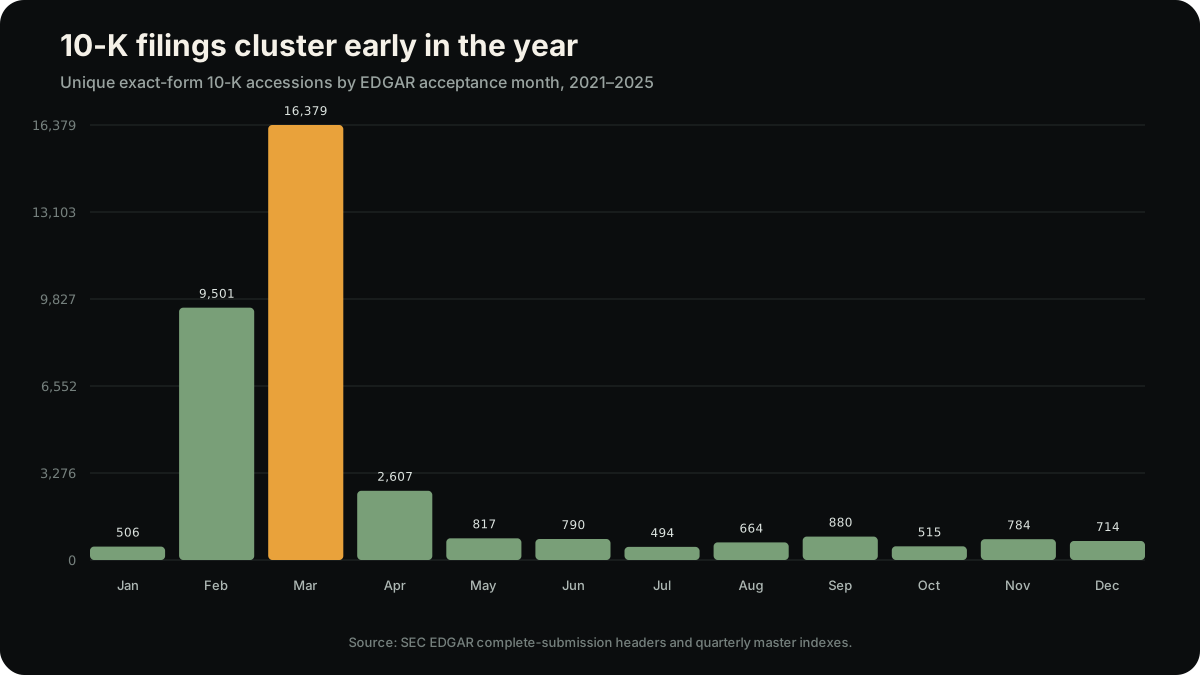
Source: Earnings Feed analysis of SEC quarterly master indexes and SEC-displayed EDGAR acceptance timestamps; data snapshot August 12, 2026.
| Acceptance month (ET) | Unique 10-K accessions | Share |
|---|---|---|
| January | 506 | 1.46% |
| February | 9,501 | 27.42% |
| March | 16,379 | 47.27% |
| April | 2,607 | 7.52% |
| May | 817 | 2.36% |
| June | 790 | 2.28% |
| July | 494 | 1.43% |
| August | 664 | 1.92% |
| September | 880 | 2.54% |
| October | 515 | 1.49% |
| November | 784 | 2.26% |
| December | 714 | 2.06% |
The standard deadline structure is consistent with this pattern. The current SEC Form 10-K instructions set three standard deadlines after fiscal year-end:
| Filer status | Standard 10-K deadline |
|---|---|
| Large accelerated filer | 60 days |
| Accelerated filer | 75 days |
| Other registrant | 90 days |
For a December 31 fiscal year-end, the standard 60-, 75-, and 90-day deadlines fall around March 1, mid-March, and late March. Weekends, federal holidays, and a valid Form 12b-25 extension can move the final date. That calendar is consistent with March's prominence, but it does not explain February by itself. A company can file before its deadline or use another fiscal year-end. This study did not assign a due date to each accession or test whether a deadline caused its filing date. The SEC Financial Reporting Manual explains the weekend, holiday, and extension rules.
The date peaks are sharp. Four of the five busiest acceptance dates fell on March 31.
| Rank | EDGAR acceptance date (ET) | Unique 10-K accessions |
|---|---|---|
| 1 | March 31, 2022 | 652 |
| 2 | March 31, 2023 | 599 |
| 3 | March 31, 2025 | 437 |
| 4 | March 31, 2021 | 434 |
| 5 | March 30, 2021 | 375 |
For portfolio-wide monitoring, this sample supports heavier coverage in February and especially March. For one registrant, its fiscal year-end, filer status, weekends or federal holidays, and any Form 12b-25 filing are more useful than the aggregate monthly peak. You can review current Form 10-K deadlines and latest filings separately from this historical timing study.
The Largest Acceptance Window Starts at 4:00 p.m. ET
EDGAR accepted more than half of the accessions from 4:00 p.m. through 5:29 p.m. ET. The 4:00 through 4:29 p.m. ET interval contained 22.74% of the full five-year dataset.
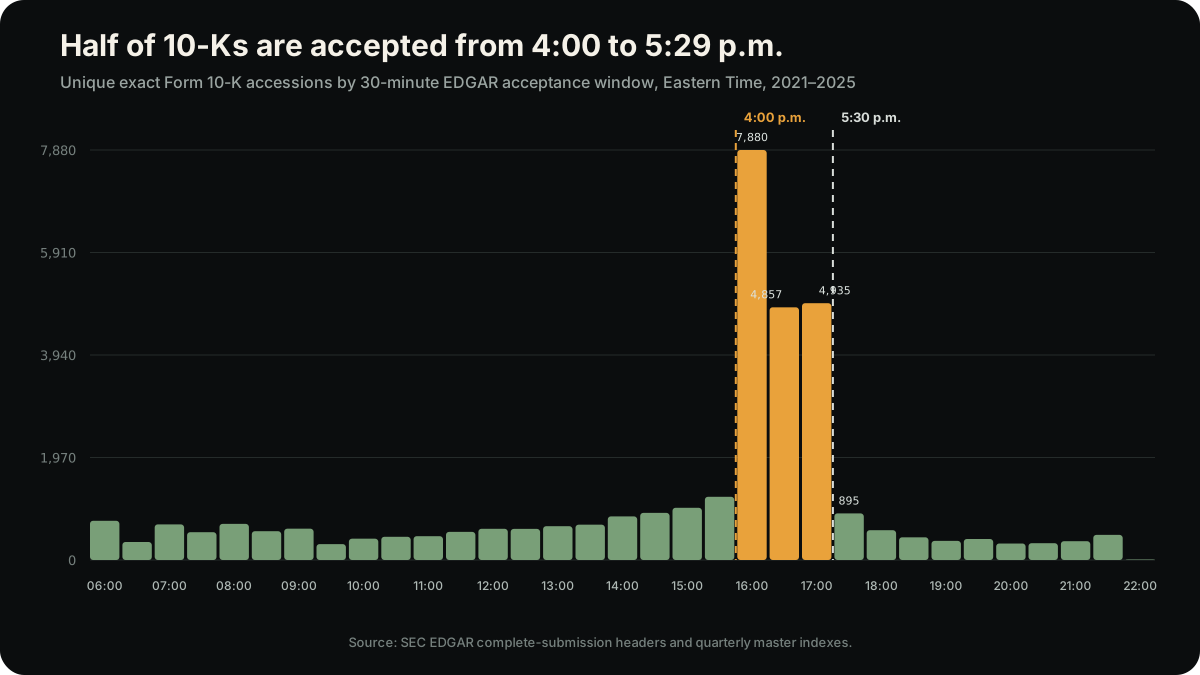
Source: Earnings Feed analysis of SEC quarterly master indexes and SEC-displayed EDGAR acceptance timestamps; data snapshot August 12, 2026.
| EDGAR acceptance time (ET) | Unique accessions | Share |
|---|---|---|
| 6:00 a.m. to 9:29 a.m. | 4,167 | 12.03% |
| 9:30 a.m. to 3:59 p.m. | 8,642 | 24.94% |
| 4:00 p.m. to 5:29 p.m. | 17,672 | 51.00% |
| 5:30 p.m. or later | 4,170 | 12.03% |
The concentration around 4:00 p.m. is a descriptive result. This study did not test why companies selected those times. It also did not compare acceptance time with earnings-release time, market-close time, or company policy.
For portfolio-wide monitoring, this historical sample supports allocating more monitoring coverage late in the afternoon as well as in the morning: 51.00% of acceptances occurred from 4:00 through 5:29 p.m. ET. This describes EDGAR acceptance, not the exact moment a filing became available on sec.gov.
The calendar and clock effects also overlap. EDGAR accepted 13,280 filings, or 38.33% of the full study, during February or March from 4:00 through 5:29 p.m. ET.
The Pattern Held Across All Five Years
The pattern appeared in every year in the sample. The February-or-March share ranged from 70.27% to 76.55%. The 4:00 through 5:29 p.m. share ranged from 48.90% to 52.40%, and the annual median acceptance time ranged from 4:12 p.m. to 4:16 p.m. ET.
| Acceptance year (ET) | Accessions | February/March share within year | 4:00 to 5:29 p.m. share within year | Median acceptance time (ET) |
|---|---|---|---|---|
| 2021 | 6,932 | 74.73% | 48.90% | 4:15 p.m. |
| 2022 | 7,539 | 75.70% | 50.64% | 4:16 p.m. |
| 2023 | 7,119 | 76.01% | 51.54% | 4:16 p.m. |
| 2024 | 6,630 | 70.27% | 51.66% | 4:14 p.m. |
| 2025 | 6,431 | 76.55% | 52.40% | 4:12 p.m. |
Year labels use the EDGAR acceptance date. The study population was selected by official filing date.
What the 5:30 p.m. EDGAR Rule Means
The SEC says EDGAR accepts filings from 6:00 a.m. to 10:00 p.m. ET, Monday through Friday, except federal holidays. This statement concerns filing-acceptance operations. It does not mean that the public EDGAR website is unavailable outside those hours.
Under the SEC filing-status guidance, most live submissions that start transmission after 5:30 p.m. ET and are accepted receive the next business day as their filing date. The SEC also says that it disseminates most such submissions on the next business day. Exact Form 10-K is not among the listed submission-type exceptions that can retain the transmission date after 5:30 p.m.
Ten official acceptance clocks in the dataset fall from 10:00:01 through 10:02:17 p.m. ET. We retained the SEC-displayed values. The data does not show why acceptance completed just after the stated operating close.
But the rule uses the time when transmission starts. Our data contains the time when EDGAR accepted the submission. A filing accepted at 5:31 p.m. could have started its transmission before 5:30 p.m. For that reason, we do not label the 4,170 filings accepted at or after 5:30 p.m. as late transmissions.
Acceptance date and official filing date differed for 3,953 accessions, or 11.41% of the study. We calculated the calendar-day difference as official filing date minus EDGAR acceptance date:
| Official filing date minus acceptance date | Accessions | Share |
|---|---|---|
| Same date (0 days) | 30,698 | 88.59% |
| +1 calendar day | 3,297 | 9.51% |
| +3 calendar days | 601 | 1.73% |
| All other date differences | 55 | 0.16% |
The +1 and +3 patterns are compatible with next-business-day dating, including a Friday-to-Monday interval. They do not prove that transmission began after 5:30 p.m. The dataset does not contain transmission-start time. The SEC can also adjust an official filing date after acceptance; it does not adjust the acceptance time itself.
Acceptance Is Not the Exact sec.gov Availability Time
An EDGAR acceptance means that a submission passed EDGAR's procedural acceptance review. It is not SEC approval of the filing. The SEC EDGAR glossary explains this distinction.
An acceptance timestamp is also not the time when the filing first became available on sec.gov. The SEC timestamp FAQ says filings are often available within one to three minutes of the EDGAR system timestamp. The delay can increase under high server load and is not guaranteed or predictable. The SEC also says there is no timestamp that shows when filing content first becomes available on sec.gov.
This study can answer, “When did EDGAR accept the 10-K?” It cannot answer, “At what exact second could the first investor open it?”
How We Built the Dataset
We used the SEC's official quarterly master indexes as the population frame. We retrieved and hashed the index snapshot on August 12, 2026. The SEC index documentation says that the SEC rebuilds full and quarterly indexes to include post-acceptance corrections and deletions. These results describe the historical index population on the retrieval date. They do not try to reconstruct every row that could have appeared in an earlier index snapshot. Read the Earnings Feed data methodology for the separate production filing pipeline.
Our method was:
- Select rows whose form type was exactly
10-Kand whose official filing date was from January 1, 2021, through December 31, 2025. - Exclude
10-K/Aamendments,10-KTtransition reports, and all other form types. - Merge duplicate index rows by SEC accession number. A joint filing can appear once for each co-filer.
- Read
<ACCEPTANCE-DATETIME>from the SEC complete-submission header and keep the Eastern clock value displayed by the SEC. - For the 15 accessions not covered by the parsed complete-submission headers, use the acceptance clock displayed on the matching SEC filing-detail page.
- Calculate months, dates, weekdays, hours, and 30-minute periods from the acceptance clock.
The raw indexes contained 35,907 rows whose form type was exactly 10-K. Grouping those rows by accession removed 1,256 co-filer duplicate rows and left 34,651 unique accessions. The unit of analysis is an accession, not a unique company. The same registrant can appear in multiple years, and one joint filing can be associated with multiple CIKs.
We obtained acceptance clocks from 34,636 locally parsed official complete-submission headers. For the remaining 15 accessions, we verified the SEC-displayed acceptance clock on the corresponding filing-detail page. This gave us acceptance-clock coverage for all 34,651 accessions.
The cohort is defined by official filing date. All acceptance-month, acceptance-date, acceptance-year, and time-of-day results use the SEC-displayed Eastern wall-clock value.
Why We Did Not Use the Submissions acceptanceDateTime Field
The SEC Submissions API and its nightly bulk archive are useful sources of company filing history. For this time-of-day study, we did not use acceptanceDateTime as the authoritative clock.
In the official bulk files, some Z-suffixed values matched the filing-detail page only after we treated the value as UTC and converted it to Eastern wall time. Other values already matched the page's Eastern clock without conversion, and one co-filed accession could appear in both representations. We treated the field as ambiguous for this analysis, not as evidence that the API is defective. We used the complete-submission header or matching filing-detail page instead.
We preserved the Eastern wall-clock value displayed by the SEC and did not infer UTC semantics from the suffix.
Download and Cite the Data
You can inspect the study inputs, results, and quality checks:
- Download the aggregate CSV
- Download the accession-level CSV (gzip)
- Open the methods, source hashes, and audit summary
Each accession-level row includes the accession number; one or more associated CIKs and company names, as applicable; the official filing date; report date; EDGAR acceptance date and time; source URL; and timestamp source.
Version: August 12, 2026 (earnings-feed-10-k-acceptance-2021-2025-v1). The research dataset is licensed under Creative Commons Attribution 4.0.
Recommended citation: Earnings Feed Research. “When Do 10-K Filings Come Out? A 2021–2025 EDGAR Acceptance-Time Study.” Earnings Feed, dataset snapshot August 12, 2026.
Read the Earnings Feed Research standards and correction policy for information about authorship, evidence, revisions, and reuse.
To report a data issue, contact Earnings Feed and include the accession number and the affected field.
Frequently Asked Questions
When do most 10-K filings come out?
In this study, 74.69% of unique accessions were accepted in February or March. March alone accounted for 47.27%. A company's deadline still depends on its fiscal year-end and filer status.
What time of day do 10-K filings hit EDGAR?
EDGAR accepted 63.03% of the unique accessions at or after 4:00 p.m. ET. The median acceptance time was about 4:15 p.m. ET. Acceptance time is not the exact sec.gov availability time.
How long after fiscal year-end is a 10-K due?
The standard deadlines are 60 days after fiscal year-end for large accelerated filers, 75 days for accelerated filers, and 90 days for all other registrants. A deadline on a weekend or federal holiday moves to the next business day. If a registrant meets Rule 12b-25 and files Form 12b-25 on time, an annual report can receive a 15-calendar-day extension.
Does EDGAR acceptance show when investors could first see the filing?
Not exactly. The SEC says filings are often available on sec.gov within one to three minutes of the EDGAR system timestamp. The delay can increase under high server load and is not guaranteed or predictable. The SEC does not publish a timestamp that shows when filing content first became available on sec.gov.
Track New 10-K Filings
The aggregate pattern recurred in each year of this five-year sample, but it does not predict the exact filing time of one registrant.
The SEC filing is the authoritative source. This study describes historical filing patterns, not investment results.